Chapter 13 · Class 11-12 & JEE/NEET
Chemical Kinetics
49 topics · 17 sections · beginner-friendly study notes · Updated
Chemical kinetics measures how fast reactions proceed and how rates depend on concentration and temperature.
Differential and integrated rate laws for zero-, first- and second-order reactions, half-life relations, collision theory and the Arrhenius equation (k = Ae^{−E_a/RT}) are core.
Mechanisms with elementary steps, rate-determining steps, molecularity vs order, and catalysis (homogeneous, heterogeneous, enzyme) explain why rate laws look the way they do.
Rate-law and Arrhenius numericals are staples; mechanism reasoning links to organic reaction pathways.
Pharmaceutical shelf life, atmospheric chemistry, industrial reactor design and enzyme kinetics.
Reaction Rate and Rate Law
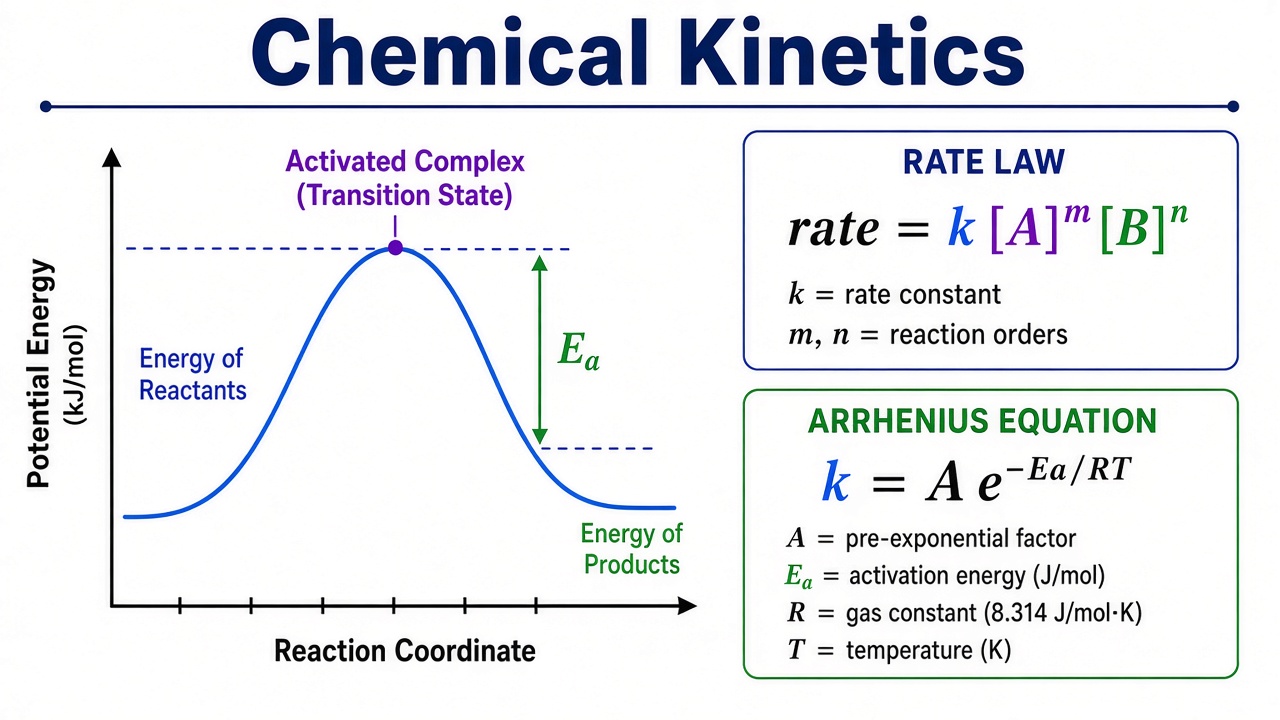
Average rate = Δc/Δt for a species (signed by stoichiometry). Instantaneous rate is the derivative. For aA + bB → products, experimental rate = k [A]^m [B]^n where m,n are orders (empirically found), not necessarily a,b. k is the rate constant with units depending on overall order.
In short: Rate says how quickly concentrations change. The rate law is an experimental recipe linking rate to concentrations.
Think about it
Every kinetics problem starts from a correct rate definition and rate law.
Rate of reaction is uniquely defined by dividing species rates by stoichiometric coefficients: rate = −(1/a)d[A]/dt = +(1/p)d[P]/dt.
Orders may be fractional or zero.
Overall order = sum of orders.
Units: first-order k in time⁻¹; second-order in concentration⁻¹ time⁻¹.
Rate laws cannot be deduced from the balanced equation unless the reaction is elementary.
Pseudo-first-order: large excess of one reactant makes its concentration effectively constant.
Key points
- Order: Exponent of a concentration in the rate law.
- Rate constant k: Proportionality constant at a fixed T.
- k depends strongly on T, weakly on concentration (ideally independent).
- Negative rates for reactants become positive “reaction rate” after dividing by −coeff.
- Spectrophotometry, pressure change (gases) and titration monitor rates.
Read more
General rate law
- m,n — Orders in A and B (—)
Integrated Rate Laws and Half-Life
Zero order: [A] = [A]₀ − kt; t₁/₂ = [A]₀/(2k). First order: ln[A] = ln[A]₀ − kt; t₁/₂ = 0.693/k (independent of [A]₀). Second order (2A or A+B equal): 1/[A] − 1/[A]₀ = kt; t₁/₂ = 1/(k[A]₀).
In short: Integrated laws tell you concentration versus time. First-order half-life is a constant stopwatch tick; zero- and second-order half-lives depend on how much you started with.
Think about it
Most kinetics numericals are integrated-law rearrangements.
Straight-line tests: [A] vs t (zero), ln[A] vs t (first), 1/[A] vs t (second).
Radioactive decay is first-order.
For first order, fraction remaining e^{−kt}; after n half-lives, (1/2)^n left.
Gas-phase first-order: pressure of reactant related if stoichiometry known (e.
g.
A → 2B).
Mixing orders (rate = k[A][B]) needs integrated forms beyond school or use isolation method.
Lifetime and shelf-life estimates in pharmacy use first-order approximations often.
Key points
- Half-life t₁/₂: Time for concentration of reactant to fall to half its value.
- Isolation method: Hold one reactant in large excess to simplify order determination.
- t₁/₂ ∝ [A]₀^{1−n} generally for nth order (single reactant).
- Never use first-order t₁/₂ formula for zero/second order.
- k determination: slope of the appropriate linear plot.
First-order integrated
- t_{1/2} — Half-life (s)
Arrhenius Equation and Activation Energy
k = A e^{−E_a/RT} where E_a is activation energy and A the pre-exponential factor. Two-temperature form: ln(k₂/k₁) = (E_a/R)(1/T₁ − 1/T₂). Higher E_a means stronger temperature sensitivity. Catalysts lower E_a for the productive path.
In short: Only collisions energetic enough clear the activation hill. Heat the system and a larger fraction of molecules make it over — rate soars.
Think about it
Temperature-effect numericals and catalyst explanations use E_a language.
Plot ln k vs 1/T is linear with slope −E_a/R. Collision theory: rate ∝ collision frequency × e^{−E_a/RT} × steric factor.
Transition
state theory speaks of an activated complex at the barrier top.
Exothermic reactions can still have large E_a (slow).
Photochemical reactions use photon energy to bypass thermal barriers.
Rule of thumb “rate doubles every 10 °C” is crude and E_a-dependent — prefer Arrhenius maths.
Key points
- Activation energy E_a: Minimum energy barrier along the reaction coordinate (Arrhenius).
- Pre-exponential A: Frequency/orientation factor in Arrhenius.
- R = 8.314 J mol⁻¹ K⁻¹; keep E_a in joules when consistent.
- Catalyst does not change ΔH of reaction; it changes path/E_a.
- Negative temperature coefficient rare (complex mechanisms).
Arrhenius
- E_a — Activation energy (J mol⁻¹)
Molecularity, Mechanisms and RDS
Molecularity is the number of species colliding in an elementary step (uni/bi/termolecular) and is always an integer. Order is experimental and may differ for multi-step mechanisms. The rate-determining step (slowest) often dictates the rate law; intermediates form in early steps and are consumed later.
In short: The balanced equation is the overall story; the mechanism is the scene-by-scene script. The slowest scene limits how fast the play finishes.
Think about it
Mechanism questions test whether you confuse molecularity with order.
Elementary step rate laws follow stoichiometry of that step.
Example
2NO + O₂ → 2NO₂ may involve NO dimer intermediate — observed order can be 2 in NO and 1 in O₂.
Steady-state and pre-equilibrium approximations appear in advanced treatments.
Termolecular elementary steps are rare (low probability).
Consistency checks: sum of elementary steps = overall; intermediates cancel; catalysts regenerate.
Photochemical mechanisms and chain reactions (H₂ + Br₂) introduce initiation/propagation/termination — sometimes sketched in JEE Advanced.
Key points
- Elementary reaction: Single-step process as written.
- Intermediate: Produced then consumed; not in overall equation.
- Molecularity defined only for elementary steps.
- Order can be zero even if reactants are essential (surface saturation).
- RDS may change with conditions — mechanisms can be condition-dependent.
Catalysis
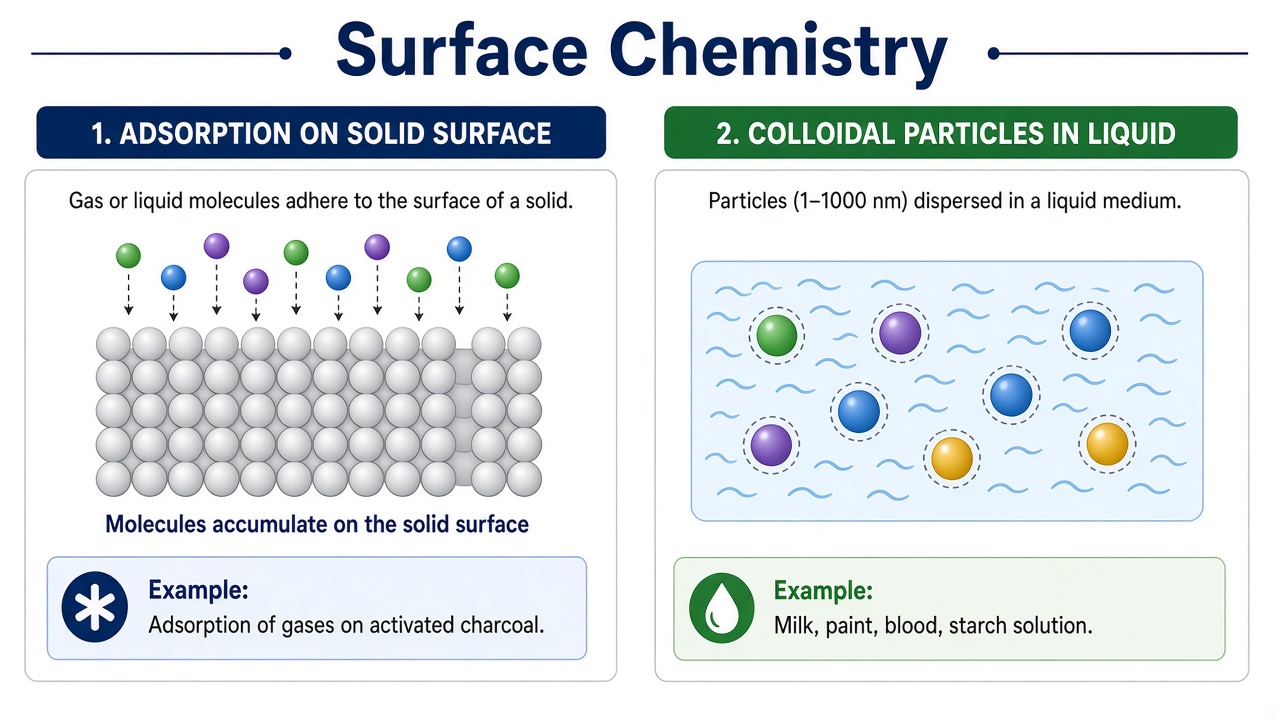
Catalysts increase rate by providing a lower-E_a path and are regenerated. Homogeneous: same phase (acid catalysis of ester hydrolysis). Heterogeneous: different phase (Fe in Haber; Pt in contact process) — adsorption of reactants is key. Autocatalysis: product catalyses the reaction. Enzymes: highly selective biological catalysts (Michaelis–Menten kinetics beyond basic syllabus).
In short: A catalyst is a reusable shortcut through a lower mountain pass — more travellers get through per hour.
Think about it
Industrial chemistry and many MCQs hinge on what catalysts do and do not change.
Positive catalysts speed up; inhibitors slow down.
Promoters improve catalyst activity; poisons bind strongly and kill active sites (As, S on Fe).
Intermediate compound formation theory and adsorption theory explain homogeneous vs heterogeneous cases.
Catalysis does not alter the position of equilibrium (K unchanged) — both forward and reverse accelerate.
Enzyme active sites show lock-and-key / induced-fit specificity; denaturation with T extremes.
Industrial catalysts are often finely divided solids to maximise surface area — link to surface chemistry.
Key points
- Promoter: Substance enhancing catalyst efficiency.
- Poison: Impurity that deactivates catalytic sites.
- Catalyst changes E_a and path, not ΔG° or K.
- Finely divided metals: larger surface
→faster heterogeneous catalysis. - Enzymes: optimal pH and temperature windows.
Comparisons
Zero vs first vs second order (single reactant)
| Zero | First | Second | |
|---|---|---|---|
| Rate law | k | k[A] | k[A]² |
| Linear plot | [A] vs t | ln[A] vs t | 1/[A] vs t |
| t₁/₂ | [A]₀/2k | 0.693/k | 1/(k[A]₀) |
| Units of k | conc/time | time⁻¹ | conc⁻¹ time⁻¹ |
Educational Significance: Diagnose order from which plot is linear and how t₁/₂ depends on [A]₀.
Solved examples
First-order reaction: k = 0.0693 min⁻¹. Find t₁/₂.
t₁/₂
Formula Applied:—Approach note: First-order half-life independent of concentration.
Initial rates: double [A] doubles rate; double [B] quadruples rate. Find orders.
Orders in A and B
Formula Applied:—Approach note: Compare experiments that change one concentration at a time.
k₁ = 2×10⁻³ at 300 K; k₂ = 8×10⁻³ at 320 K. Find E_a. (R=8.314)
E_a
Formula Applied:—Approach note: Keep T in kelvin; compute (1/T₁−1/T₂) carefully.
Zero-order: [A]₀ = 0.2 M, k = 0.01 M min⁻¹. Time for completion?
t
Formula Applied:—Approach note: Zero-order can finish in finite time; first-order only approaches zero asymptotically.
Real-world applications
Chemical Kinetics outside the classroom
Pharmaceutical shelf life, atmospheric chemistry, industrial reactor design and enzyme kinetics.
Common mistakes
❌ Myth: Order equals the stoichiometric coefficient in the balanced equation.
Why this is wrong: Order is experimental; only elementary steps match molecularity to stoichiometry.
✅ Verified Truth: Deduce order from data, not from the overall equation alone.
⚠️ Exam Tip: Ask whether the step is elementary before equating order and molecularity.
❌ Myth: A catalyst changes the equilibrium constant to favour products.
Why this is wrong: Catalysts accelerate both directions; K unchanged.
✅ Verified Truth: Equilibrium yield fixed by thermodynamics; time to reach it falls.
⚠️ Exam Tip: Separate kinetic role of catalyst from ΔG°/K.
❌ Myth: Higher temperature always lowers activation energy.
Why this is wrong: E_a is a path property; T changes the fraction of energetic collisions.
✅ Verified Truth: k rises with T mainly via the exponential factor, not by shrinking E_a.
⚠️ Exam Tip: Catalysts lower E_a; heating raises k at fixed E_a.
Revision notes
Chemical kinetics measures how fast reactions proceed and how rates depend on concentration and temperature. Differential and integrated rate laws for zero-, first- and second-order reactions, half-life relations, collision theory and the Arrhenius equation (k = Ae^{−E_a/RT}) are core. Mechanisms with elementary steps, rate-determining steps, molecularity vs order, and catalysis (homogeneous, heterogeneous, enzyme) explain why rate laws look the way they do.
High-Yield Quick Revision Points
- rate=k[A]^m[B]^n; orders experimental.
- Integrated: zero [A], first ln[A], second 1/[A] plots.
- t₁/₂: first 0.693/k; zero ∝[A]₀; second ∝1/[A]₀.
- Arrhenius k=Ae^{−E_a/RT}; catalyst lowers E_a, not K.
- Molecularity for elementary steps; RDS controls rate law.
Master Formula Cheat Sheet
Practice questions
Unit of k for a first-order reaction:
First-order: 75% complete in how many half-lives?
t₁/₂ independent of [A]₀ for which order?
If rate = k[A]² and [A] triples, rate multiplies by?
Slope of ln k vs 1/T equals:
Second-order t₁/₂ if k=0.5 L mol⁻¹ min⁻¹ and [A]₀=0.2 M? (min)