Chapter 30 · Class 11-12 & JEE/NEET
Biomolecules
65 topics · 14 sections · beginner-friendly study notes · Updated
Biomolecules — carbohydrates, proteins, vitamins, nucleic acids and enzymes — connect organic functional-group chemistry to living systems.
Classification, stereochemistry of sugars, amino-acid zwitterions, peptide bonds, DNA/RNA base pairing and enzyme catalysis are standard JEE/NEET theory topics.
NEET weighs biomolecules heavily; JEE Main asks crisp structure/classification items every session.
Drug design, nutrition science, genetic engineering and diabetes care (insulin, glucose monitoring) apply these structures daily.
Carbohydrates: Classification and Glucose
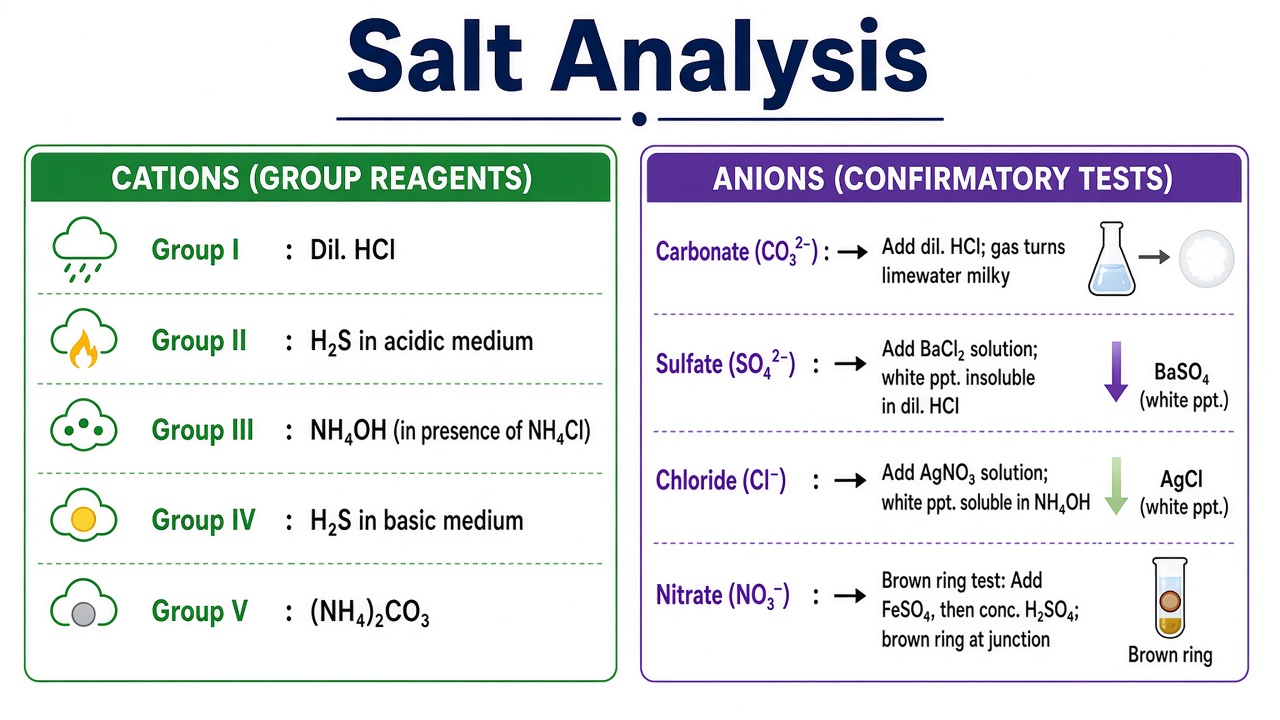
Carbohydrates are polyhydroxy aldehydes/ketones or substances hydrolysing to them. Monosaccharides (glucose, fructose), disaccharides (sucrose, maltose, lactose), polysaccharides (starch, cellulose, glycogen). Glucose is an aldohexose existing as open-chain and pyranose anomers (α/β).
In short: Sugars are hydrated carbon chains with many OH groups; glucose is the body’s primary sugar and can open to an aldehyde or close into a ring.
Think about it
Reducing vs non-reducing and anomers are classic MCQs. Blood glucose regulation and HbA1c monitoring are clinical carbohydrate chemistry.
Evidence: reaction with HCN, Tollen’s/Fehling’s, acetylation (5 OH), bromopolys → gluconic, nitric → saccharic (both ends oxidised).
Kiliani–Fischer lengthening; Ruff degradation shortening — occasional.
Mutarotation: α/β anomers equilibrate via open chain; specific rotation changes.
Sucrose non-reducing (both anomeric carbons tied in glycoside); maltose/lactose reducing.
Starch = amylose + amylopectin; cellulose β-1,4 glucose — humans lack cellulase.
Remember that acetylation of glucose revealing five OH groups is a counting proof, not decoration: open-chain C₆H₁₂O₆ has four secondary plus one primary alcohol after the aldehyde is accounted for in the aldose structure.
Key points
- Anomer: Diastereomer differing at the hemiacetal anomeric carbon.
- Reducing sugar: Has free anomeric OH — can open to aldehyde/ketone.
- Fructose is ketohexose but reduces Fehling’s via tautomerism in alkali.
- Invert sugar = equimolar glucose + fructose from sucrose hydrolysis.
Amino Acids and Peptides
α-Amino acids have NH₂ and COOH on the same carbon (except proline secondary). In water they exist as zwitterions ⁺H₃N–CHR–COO⁻. Peptide bond is an amide linkage; peptides/proteins are condensation polymers of amino acids.
In short: Amino acids are molecules with both an acid and a base end; in water they self-salt into zwitterions and can daisy-chain into proteins.
Think about it
Zwitterion + pI reasoning is a favourite short conceptual. Aspartame is a dipeptide sweetener — peptide chemistry in food tech.
Essential vs non-essential amino acids.
Isoelectric point pI: pH where net charge zero — least soluble, no migration in electric field.
Electrophoresis separates amino acids.
Peptide bond planar due to resonance; N–C partial double bond.
N-terminus / C-terminus naming.
Disulphide bridges from cysteine.
Ninhydrin test purple for α-amino acids.
Key points
- Zwitterion: Internal salt with + and − charges.
- Isoelectric point: pH of zero net charge.
- Glycine is achiral; all other standard α-amino acids chiral.
- Acidic side chains lower pI; basic side chains raise pI.
Generic α-amino acid
- R — Side chain (—)
Proteins: Structure and Denaturation
Primary structure = amino-acid sequence. Secondary = local H-bonded α-helix / β-sheet. Tertiary = 3D fold via H-bond, ionic, hydrophobic, S–S. Quaternary = multiple subunits (haemoglobin). Denaturation unfolds higher structure without breaking primary sequence (heat, pH, urea, heavy metals).
In short: Sequence is primary; coils/sheets secondary; overall shape tertiary; team of chains quaternary — denaturation messes up shape but not the bead order.
Think about it
Four-level structure questions are high-yield NEET items. Cooking egg white irreversibly denatures albumin — kitchen protein chemistry.
Fibrous (keratin, collagen) vs globular (enzymes, haemoglobin).
Native conformation crucial for function.
Renaturation sometimes possible.
Sickle-cell: single AA change in primary wrecks quaternary behaviour — illustrates sequence→function.
Key points
- Denaturation: Loss of native higher-order structure.
- Conjugated protein: Protein + prosthetic group (e.g. haemoglobin + heme).
- Peptide bonds survive mild denaturation; hydrolysis needs acid/enzymes.
- α-Helix stabilised by H-bonds parallel to axis.
Enzymes and Vitamins
Enzymes are biological catalysts (mostly proteins) with high specificity; activity depends on pH/T. Vitamins are essential micronutrients: water-soluble (B-complex, C) and fat-soluble (A, D, E, K) with characteristic deficiency diseases.
In short: Enzymes speed life’s reactions in mild conditions; vitamins are tiny helpers you must eat because you cannot make enough.
Think about it
Deficiency disease matching is pure recall scoring in NEET. Industrial enzymes in detergents and HFCS production — applied biocatalysis.
Lock-and-key vs induced fit.
Cofactors/coenzymes (often vitamin-derived: NAD⁺, FAD).
Vitamin C = ascorbic acid (scurvy); D (rickets); A (night blindness); B₁₂ (pernicious anaemia); K (clotting).
Fat-soluble can accumulate to toxicity.
Enzyme naming: often -ase on substrate.
Key points
- Coenzyme: Organic cofactor, often vitamin-derived.
- Fat-soluble vitamins: A, D, E, K.
- Water-soluble vitamins rarely stored — regular intake needed.
- Extreme T/pH denature enzymes like other proteins.
Nucleic Acids
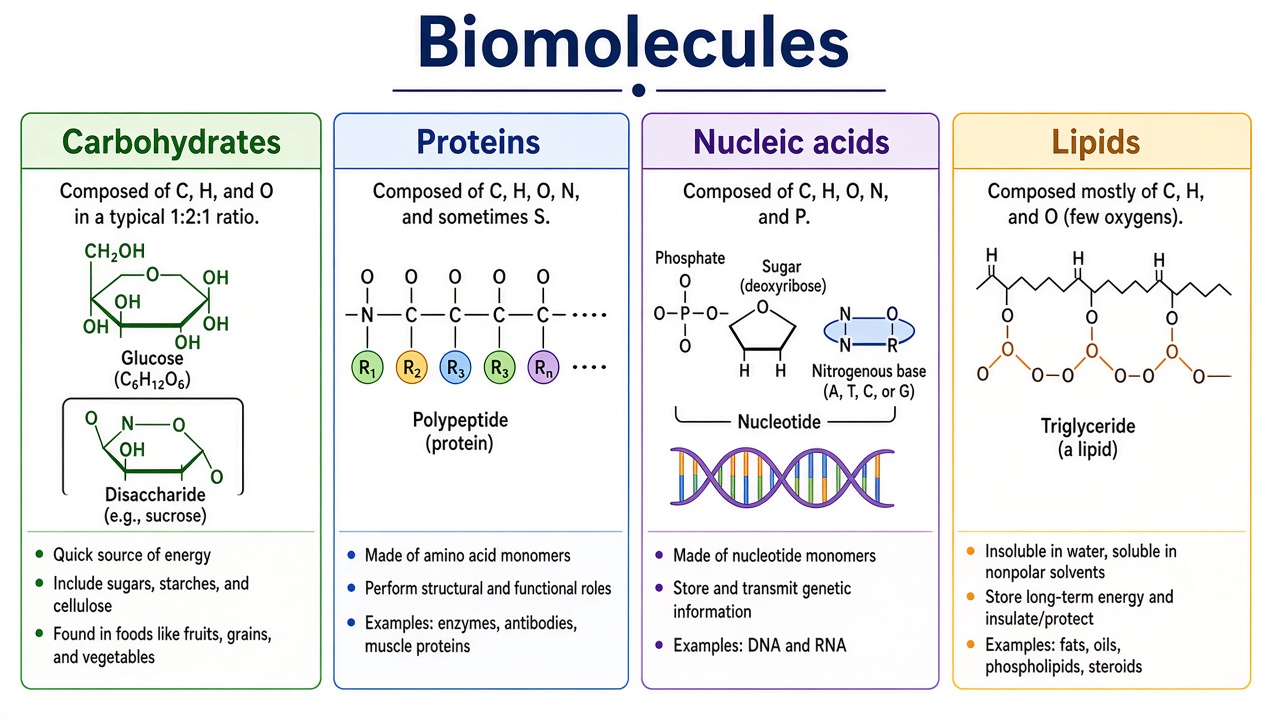
DNA/RNA are polymers of nucleotides (base + pentose + phosphate). DNA bases A,T,G,C with A–T (2 H-bonds) and G–C (3 H-bonds); RNA uses U instead of T. DNA double helix (Watson–Crick); RNA usually single-stranded.
In short: DNA is a twisted ladder of base pairs carrying genetic code; RNA helps express that code.
Think about it
Base-pair H-bond counts and DNA vs RNA differences are standard MCQs. PCR, mRNA vaccines and genetic tests are nucleic-acid technology.
Nucleoside = base + sugar; nucleotide adds phosphate.
5′–3′ phosphodiester backbone.
Chargaff’s rules.
Replication/transcription/translation overview at NCERT depth.
Differences: DNA deoxyribose + T; RNA ribose + U. ATP as energy currency is a nucleotide triphosphate.
Key points
- Nucleotide: Base + sugar + phosphate.
- Complementary base pairing: A–T/U and G–C specificity.
- G–C rich DNA melts at higher T (3 H-bonds).
- Antiparallel strands: 5′
→3′ opposite 3′→5′.
Comparisons
DNA vs RNA
| DNA | RNA | |
|---|---|---|
| Sugar | Deoxyribose | Ribose |
| Bases | A, T, G, C | A, U, G, C |
| Structure | Double helix usually | Single strand usually |
| Main role | Genetic store | Expression / catalysis (ribozymes) |
Educational Significance: One table covers most DNA/RNA comparison questions.
Solved examples
Why is sucrose non-reducing but maltose reducing?
- Two disaccharides
Explain
Formula Applied:—Approach note: Reducing ⇒ free hemiacetal/anomeric OH.
Draw/describe the zwitterion of glycine and state net charge at pI.
- Glycine
Zwitterion + charge at pI
Formula Applied:—Approach note: pI is defined by zero net charge.
Number of hydrogen bonds in A–T vs G–C pairs?
- Watson–Crick pairs
2 and 3
Formula Applied:—Approach note: More G–C ⇒ higher melting temperature of DNA.
Heating egg albumin makes it insoluble. Which structure levels change?
- Denaturation
Levels affected
Formula Applied:—Approach note: Denaturation ≠ hydrolysis.
Real-world applications
Biomolecules outside the classroom
Drug design, nutrition science, genetic engineering and diabetes care (insulin, glucose monitoring) apply these structures daily.
Common mistakes
❌ Myth: All disaccharides are non-reducing.
Why this is wrong: Maltose and lactose are reducing; sucrose is not.
✅ Verified Truth: Check free anomeric carbons.
⚠️ Exam Tip: Sucrose is the famous non-reducing exception among common disaccharides.
❌ Myth: Denaturation breaks peptide bonds.
Why this is wrong: Peptide bonds need hydrolysis; denaturation unfolds.
✅ Verified Truth: Primary structure survives mild denaturation.
⚠️ Exam Tip: Use “hydrolysis” only when peptide bonds break.
❌ Myth: Vitamin C is fat-soluble.
Why this is wrong: Ascorbic acid is water-soluble.
✅ Verified Truth: A, D, E, K fat-soluble; B and C water-soluble.
⚠️ Exam Tip: Memorise ADEK as fat-soluble set.
Revision notes
Biomolecules — carbohydrates, proteins, vitamins, nucleic acids and enzymes — connect organic functional-group chemistry to living systems. Classification, stereochemistry of sugars, amino-acid zwitterions, peptide bonds, DNA/RNA base pairing and enzyme catalysis are standard JEE/NEET theory topics.
High-Yield Quick Revision Points
- Sugars: mono/di/poly; anomers; reducing if free anomeric OH.
- Amino acids zwitterions; pI net charge zero; peptide = amide.
- Protein: primary→quaternary; denaturation unfolds.
- Vitamins: ADEK fat; B/C water; match deficiencies.
- DNA A–T (2), G–C (3); RNA U instead of T.
Master Formula Cheat Sheet
Practice questions
Which is a non-reducing sugar?
Zwitterion of amino acid has
Fat-soluble vitamin is
H-bonds between G and C in DNA?
Secondary structure example is
Base unique to RNA is