Chapter 07 · Class 11-12 & JEE/NEET
Chemical Equilibrium
32 topics · 8 sections · beginner-friendly study notes · Updated
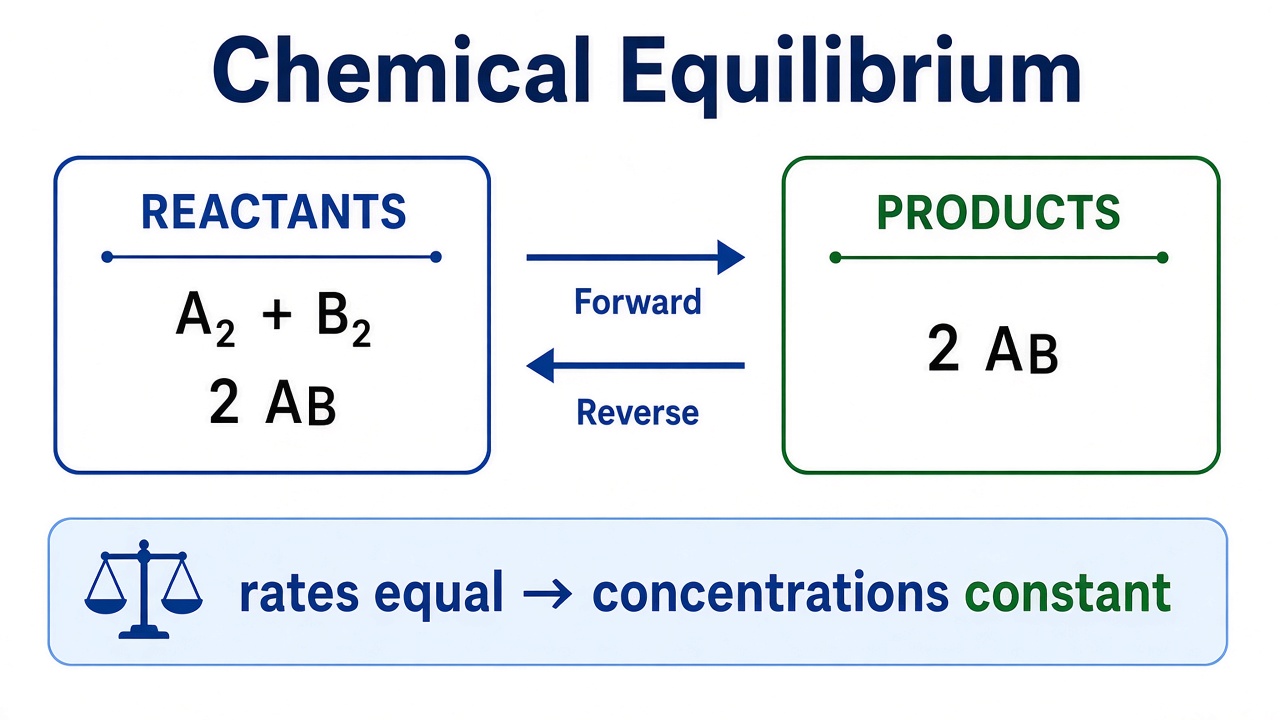
Chemical equilibrium is a dynamic state where forward and reverse rates are equal and macroscopic concentrations stay constant.
The law of mass action defines K_c and K_p; their magnitudes measure how far reactions proceed.
Le Chatelier’s principle predicts shifts when concentration, pressure or temperature changes.
Relation K_p = K_c(RT)^{Δn} and ΔG° = −RT ln K connect equilibrium to thermodynamics.
ICE tables solve equilibrium composition numericals.
Equilibrium numericals and shift reasoning appear throughout physical chemistry and industrial Haber/Contact process questions.
Ammonia synthesis optimisation, blood pH buffers (with ionic equilibrium) and metabolic pathway regulation.
Dynamic Equilibrium and Equilibrium Constant
At chemical equilibrium forward and reverse rates are equal. For aA + bB ⇌ cC + dD, K_c = [C]^c[D]^d / ([A]^a[B]^b) at a given T. K depends only on temperature for a given reaction, not on initial amounts (though position does). Pure solids and pure liquids are omitted from K (activity ≈ 1).
In short: Reactions do not “finish”; they settle where forward and reverse traffic match. K tells you whether products or reactants dominate that balance.
Think about it
K is the quantitative heart of every equilibrium problem.
Large K (≫1) ⇒ product-favoured; small K ⇒ reactant-favoured.
K is related to elementary rate constants by K = k_f/k_r only for single-step mechanisms; for multi-step, K still exists thermodynamically.
Heterogeneous example: CaCO₃(s) ⇌ CaO(s) + CO₂(g), K_p = P_CO₂.
Water in dilute aqueous equilibria is omitted when solvent.
Thermodynamic equilibrium constant uses activities; school K_c uses concentrations in mol L⁻¹ — still powerful if used consistently.
Quotient Q has the same form as K with instantaneous concentrations; Q < K ⇒ forward; Q > K ⇒ reverse; Q = K ⇒ equilibrium.
Key points
- Homogeneous equilibrium: All species in one phase.
- Reaction quotient Q: Mass-action expression away from equilibrium.
- Never include [solid] or [pure liquid] in school K expressions.
- K for reverse reaction is 1/K_forward.
- Multiplying a reaction by n raises K to the power n.
Read more
K_c
- K_c — Equilibrium constant in concentration ((mol L⁻¹)^{Δn})
K_p, K_c Relation and Partial Pressures
K_p uses partial pressures in bar (or atm as in many texts): K_p = (P_C^c P_D^d)/(P_A^a P_B^b). Relation: K_p = K_c (RT)^{Δn} where Δn = (c+d) − (a+b) for gas-phase stoichiometric change, with R matching pressure–concentration units (0.0821 if P in atm and c in mol L⁻¹).
In short: When gases are involved you can write K with pressures. K_p and K_c differ if the mole count of gas changes.
Think about it
Many numericals give P_total and α — you must fluidly switch K_p/K_c forms.
If Δn = 0, K_p = K_c.
Partial pressure P_i = χ_i P_total.
For 2SO₂ + O₂ ⇌ 2SO₃, Δn = −1, so K_p = K_c/RT.
Expressing K in terms of degree of dissociation α and total pressure is common: for PCl₅ ⇌ PCl₃ + Cl₂, if starting from 1 mol PCl₅, K_p = (α² P)/(1−α²).
Always define the balanced equation before writing Δn.
Units: strictly K thermodynamic is dimensionless; exam problems still treat numerical K_p/K_c with implied standard states.
Key points
- Δn: Change in moles of gas in the balanced equation.
- Degree of dissociation α: Fraction of reactant that dissociates at equilibrium.
- T in kelvin in (RT)^{Δn}.
- Adding inert gas at constant volume does not change partial pressures of reactants
→no shift; at constant pressure it dilutes and can shift if Δn ≠ 0. - Catalyst does not change K; it only shortens time to arrive.
K_p–K_c link
- Δn — moles gas products − moles gas reactants (—)
ICE Tables and Equilibrium Calculations
ICE (Initial, Change, Equilibrium) tables organise stoichiometric changes. Let x be the mole (or molarity) change scaled by coefficients; substitute equilibrium concentrations into K and solve for x. When K is very small, x ≈ negligible vs initials (approximation). When K is large, reaction goes nearly to completion then back-dissociates slightly.
In short: Write what you start with, what changes by x, what remains, plug into K, solve for x.
Think about it
ICE mastery turns word problems into algebra you can finish under exam time pressure.
Always check approximation: if x < 5% of initial, approximation is usually accepted in school problems.
Quadratic formula for exact ax² + bx + c = 0 when needed.
For activity problems with more than one unknown, use stoichiometry relations and charge balance (ionic equilibrium).
Percentage dissociation = 100α.
Dilution effects: for N₂O₄ ⇌ 2NO₂, decreasing pressure (increasing V) increases α.
Simultaneous equilibria share species — advanced but common in acid–base.
Key points
- Approximation method: Neglect x beside initial concentration when K is tiny.
- Quadratic solution: Exact root when approximation fails.
- Convert everything to molarity before K_c if volumes matter.
- Closed vessel assumptions: no matter loss.
- Watch significant figures; K data often limit precision.
Le Chatelier's Principle
If a stress is applied to a system at equilibrium, the system shifts to partially counteract the stress. Adding reactant shifts forward; increasing P (by decreasing V) favours the side with fewer gas moles; increasing T favours the endothermic direction; catalysts do not shift equilibrium position.
In short: Push the balance and it tips the other way to push back — more heat, more pressure, or more of a chemical you added.
Think about it
Qualitative prediction tool for industrial and exam “what happens if” questions.
Haber: N₂ + 3H₂ ⇌ 2NH₃, ΔH < 0.
High P favours NH₃ (Δn < 0); low T favours NH₃ thermodynamically but slows rate — industrial compromise ~400–500 °C with Fe catalyst and high P. Contact process: 2SO₂ + O₂ ⇌ 2SO₃ similarly.
Removing product as it forms drives conversion.
Inert gas at constant P increases volume → shifts to more gas moles.
Temperature changes alter K itself (van’t Hoff): exothermic ⇒ K decreases as T rises.
Concentration stresses change Q instantly; system shifts until Q returns to K.
Key points
- Stress: Change in concentration, pressure/volume or temperature.
- van’t Hoff qualitatively: Exothermic reactions lose K when heated.
- Adding solid does not shift (activity fixed) if some solid already present.
- Pressure effects matter only when Δn_g ≠ 0.
- Do not confuse rate (catalyst, T) with equilibrium yield (K, Le Chatelier).
Thermodynamics of Equilibrium
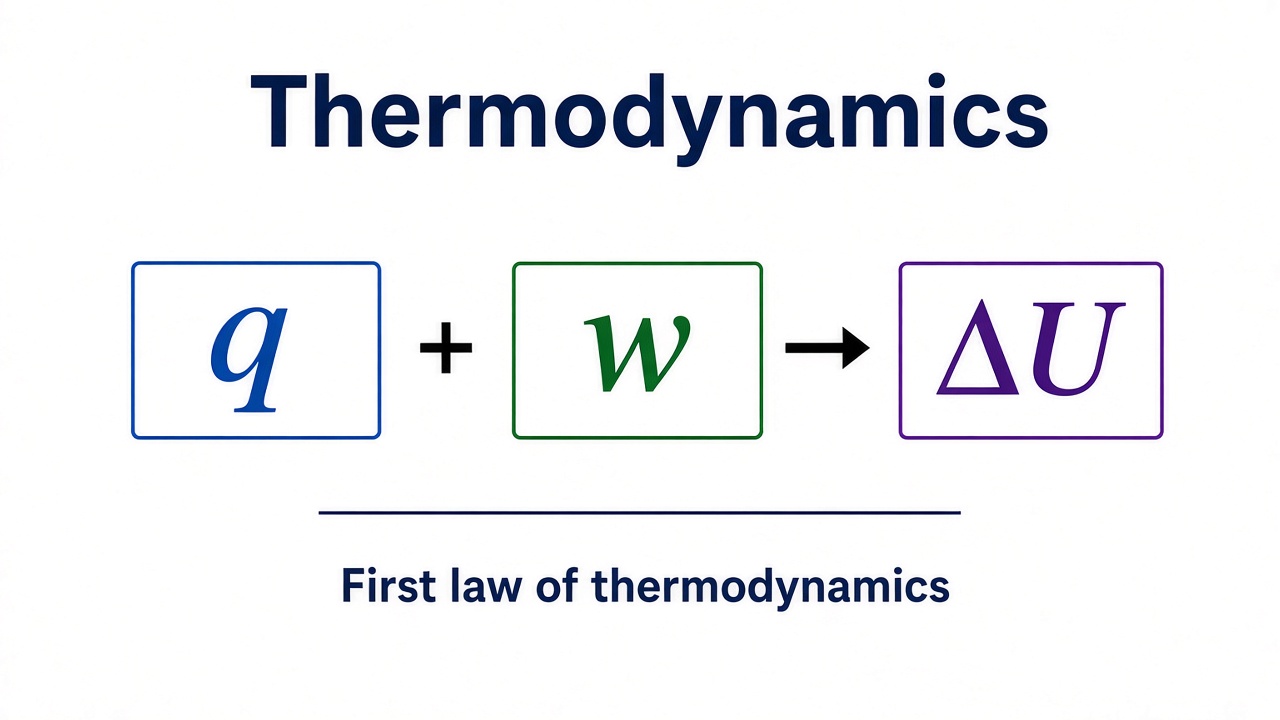
ΔG = ΔG° + RT ln Q; at equilibrium ΔG = 0 and Q = K so ΔG° = −RT ln K. Thus K > 1 when ΔG° < 0. Temperature dependence: van’t Hoff d ln K / dT = ΔH° / RT². Coupled reactions can drive unfavourable steps by consuming products.
In short: If standard free energy drops a lot when products form, K is large. Heat a reaction and K slides according to whether the reaction absorbs or releases heat.
Think about it
Gives quantitative meaning to K and predicts how K moves with temperature.
Even if ΔG° > 0 (K < 1), some products form; “non-spontaneous” under standard conditions does not mean zero conversion.
Plotting ln K vs 1/T gives −ΔH°/R slope (assuming ΔH° constant).
Relation to electrochemistry: K from E° via nFE° = RT ln K. Distinguishing ΔG and ΔG° prevents many MCQ traps: ΔG° is fixed at a T; ΔG depends on actual Q.
Key points
- Standard conditions: Activities = 1 for ΔG° definition.
- van’t Hoff equation: Temperature derivative of ln K linked to ΔH°.
- ΔG° = −2.303 RT log₁₀ K useful with common logs.
- Catalysts equalise rates; K unchanged.
- K is constant only at fixed temperature.
Comparisons
Effect of changes on equilibrium yield (general)
| Change | Effect on K | Effect on position |
|---|---|---|
| Add reactant | None | Shifts forward |
| Increase T (exo rxn) | K decreases | Shifts reverse |
| Increase P (Δn<0) | None | Shifts forward |
| Add catalyst | None | No shift; faster arrival |
Educational Significance: Separate what changes K (only T) from what changes position at fixed K.
Solved examples
For H₂ + I₂ ⇌ 2HI, K_c = 50. If [H₂]=[I₂]=[HI]=1 M, which way does reaction go?
Direction
Formula Applied:—Approach note: Compare Q and K before predicting shift.
N₂O₄ ⇌ 2NO₂ has K_c = 0.36 at some T. Start with 0.2 mol N₂O₄ in 1 L, no NO₂. Find equilibrium [NO₂].
- K_c = 0.36
- V = 1 L
- n₀(N₂O₄)=0.2
[NO₂]_eq
Formula Applied:—Approach note: Verify by substitution into K.
For a reaction with Δn = −2, K_c = 10 at 300 K. Find K_p. (R = 0.0821)
K_p
Formula Applied:—Approach note: Negative Δn makes K_p < K_c when RT > 1.
PCl₅ ⇌ PCl₃ + Cl₂. At equilibrium in a vessel, total P = 2 atm, α = 0.4 for pure PCl₅ start. Find K_p.
K_p
Formula Applied:K_p = (α²P)/(1−α²)Approach note: Derive mole fractions carefully when asked from scratch.
Real-world applications
Chemical Equilibrium outside the classroom
Ammonia synthesis optimisation, blood pH buffers (with ionic equilibrium) and metabolic pathway regulation.
Common mistakes
❌ Myth: A catalyst increases the yield of products at equilibrium.
Why this is wrong: Catalysts speed both directions equally; K unchanged.
✅ Verified Truth: Yield is fixed by thermodynamics; catalyst shortens waiting time.
⚠️ Exam Tip: Haber catalyst helps rate, not K.
❌ Myth: Equilibrium means concentrations of reactants and products are equal.
Why this is wrong: Equilibrium means rates are equal; concentrations satisfy K, not necessarily 1:1.
✅ Verified Truth: Large or small K means unequal concentrations are normal.
⚠️ Exam Tip: Write K expression instead of assuming equality.
❌ Myth: Increasing temperature always increases product yield.
Why this is wrong: Only endothermic directions are favoured by higher T.
✅ Verified Truth: For exothermic reactions, K and product yield fall as T rises.
⚠️ Exam Tip: Check ΔH sign before applying Le Chatelier on T.
Revision notes
Chemical equilibrium is a dynamic state where forward and reverse rates are equal and macroscopic concentrations stay constant. The law of mass action defines K_c and K_p; their magnitudes measure how far reactions proceed. Le Chatelier’s principle predicts shifts when concentration, pressure or temperature changes. Relation K_p = K_c(RT)^{Δn} and ΔG° = −RT ln K connect equilibrium to thermodynamics. ICE tables solve equilibrium composition numericals.
High-Yield Quick Revision Points
- Equilibrium: r_f = r_r; K from mass action.
- Omit pure solids/liquids; Q vs K gives direction.
- K_p = K_c(RT)^{Δn}.
- ICE tables + α for numericals.
- Le Chatelier: T changes K; catalyst does not.
- ΔG° = −RT ln K.
Master Formula Cheat Sheet
Practice questions
For 2A(g) ⇌ B(g), increasing pressure shifts equilibrium:
K_c for A ⇌ B if [A]=0.2, [B]=0.8 at eq.?
Which does not affect K?
Δn for N₂+3H₂⇌2NH₃?
If Q > K, the net reaction:
K_p/K_c for Δn=0?